
Key takeaway
Couples therapy is a structured form of psychotherapy that helps partners understand recurring patterns, communicate more honestly, repair trust, and decide how they want their relationship to move forward. It is not only for couples close to separation. Many people arrive because something feels flat or stuck and they would rather fix it now. If distance abroad is part of your story, how moving abroad changes expat relationships covers that context, and couples therapy for expats is where support begins.
They are arguing about the dishwasher again. Not really about the dishwasher. One feels like the only adult in the house. The other feels like nothing they do registers. They will settle the dishes tonight and have this same fight in nine days, wearing a different costume.
What Is Couples Therapy?
Couples therapy treats the relationship itself as the client, rather than treating one partner as the problem. Both partners usually attend together, and the therapist works to identify the pattern between you instead of assigning blame. The goal may be repair, clearer communication, honest clarity, or a more respectful separation. You do not need to be married.
The terminology is looser than people expect. In everyday use, couples therapy and couples counselling mean much the same thing, marriage counselling is the version aimed at married partners, and relationship therapy is the broadest term. Individual therapy is the real difference: there the focus is one person's inner world, while here it is the space between two people.
Couples therapy is not about deciding who is right. It is about understanding what keeps happening between you and learning how to respond differently.
How Does Couples Therapy Work?
Couples therapy works by making an invisible pattern visible, then practising something different. The therapist watches how you two actually interact, names the loop you are stuck in, and helps you interrupt it. It is active and collaborative rather than two people taking turns complaining while someone nods.
The couples therapy process usually moves through these stages:
- Initial assessment of history and what brought you now
- Identifying recurring patterns rather than cataloguing incidents
- Agreeing on goals you both recognise
- Learning and practising new skills for conflict and repair
- Exploring the emotions underneath the surface argument
- Applying changes between sessions, often called couples therapy homework
- Reviewing progress as things shift
Expect the therapist to interrupt you. That is not rudeness, it is the job. Stopping a familiar spiral mid-motion is often the most useful thing that happens all week.
The visible argument is often not the real problem. Therapy looks beneath the topic of the fight to the pattern that keeps bringing the couple back there.
What Happens in the First Couples Therapy Session?
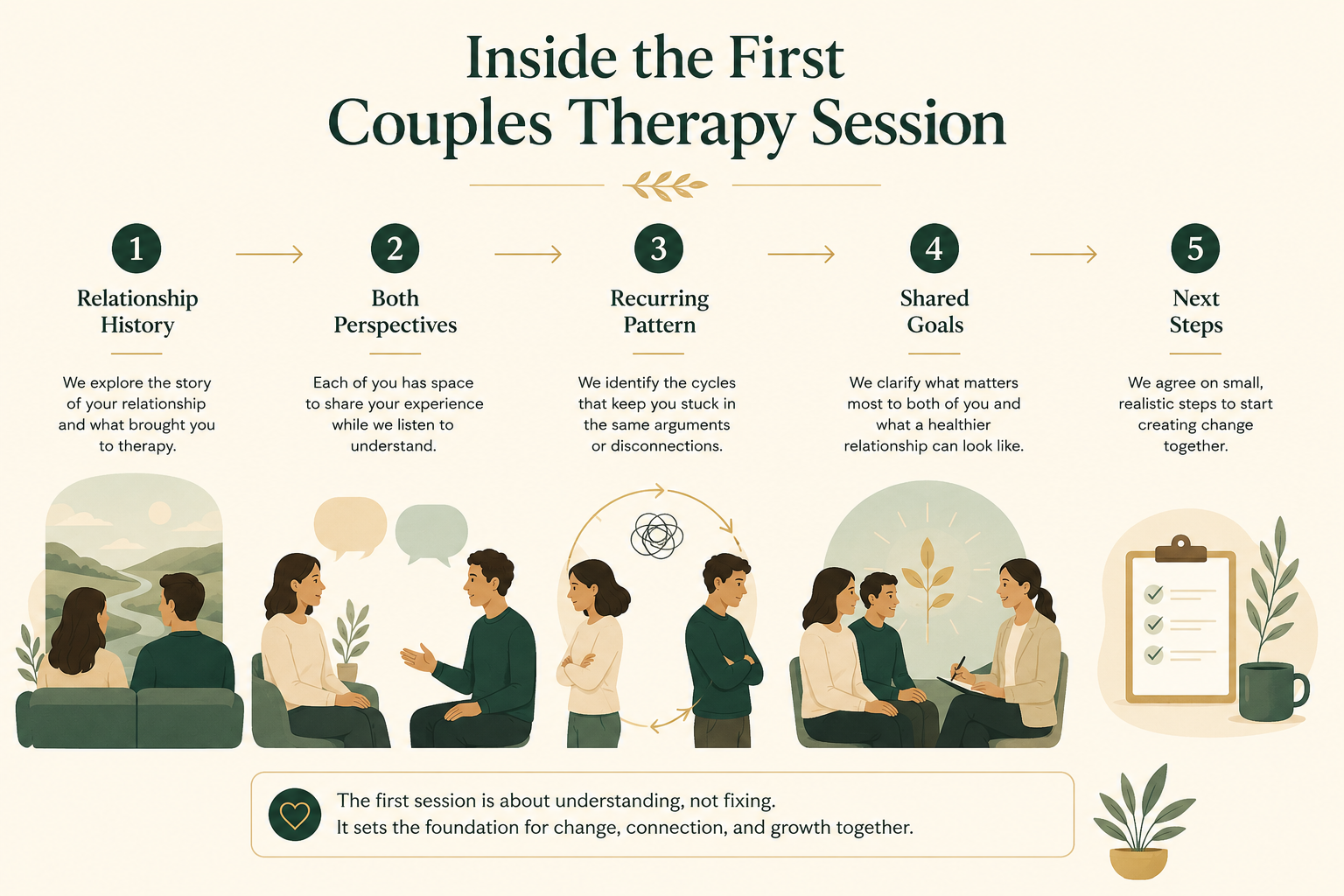
The first session is usually an assessment, not a confrontation or an instant solution. The therapist explains confidentiality and boundaries, asks about your relationship history, and hears each partner's perspective. Expect questions about what is painful, what still works, and what you want therapy to achieve.
Some therapists include individual check-ins early on, others do not. Most first sessions end with an agreement about next steps rather than a verdict.
Realistic first couples therapy session questions include:
- What brings you here now?
- When did the problem begin?
- What happens during a typical argument?
- What have you already tried?
- What would feel different if therapy helped?
- What still works well between you?
What Does a Couples Therapist Actually Do?
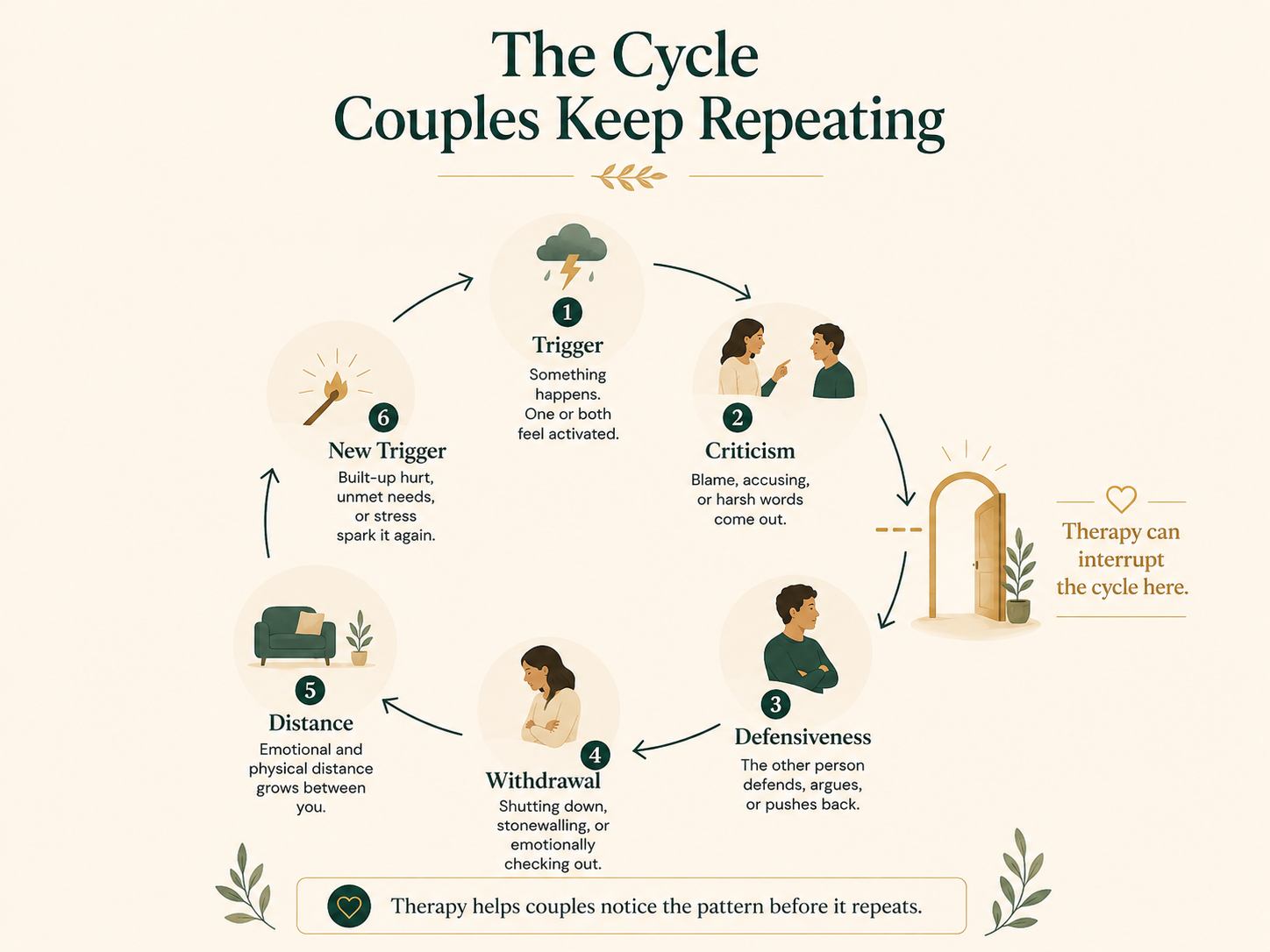
A couples therapist manages the conversation you cannot manage alone. They create a balanced environment, notice interaction patterns, slow things down when they accelerate, and help each partner say the vulnerable thing underneath the accusation. They also challenge blame, contempt, withdrawal, and defensiveness when those appear.
Most people privately worry the therapist will take the other side. A good therapist is not a judge and does not award points. But neutrality does not mean pretending everything is equivalent. A skilled therapist holds both people fairly while still naming manipulation, intimidation, betrayal, or contempt for what it is.
What Are the Benefits of Couples Therapy?
The benefits of couples therapy tend to be practical rather than mystical. Communication becomes clearer, the same argument stops repeating, and conflict becomes less destructive. Many couples describe finally understanding what their partner was actually asking for underneath years of poorly worded requests.
Commonly reported gains include rebuilding trust, improved intimacy, healthier conflict, stronger boundaries, better teamwork on money and parenting, a clearer grasp of each other's attachment needs, and help navigating major decisions. Some gain something quieter: an honest answer about whether and how they want to continue.
Success does not always mean staying together. Sometimes success means repairing the relationship. Sometimes it means reaching clarity without causing more damage.
Does Couples Therapy Work?
Couples therapy works for many couples, though not all, and the evidence is strongest for structured, well-researched approaches. A 2022 comprehensive meta-analysis in Couple and Family Psychology: Research and Practice examined 20 studies covering 332 couples and found that around 70 percent of couples were symptom free by the end of Emotionally Focused Therapy, with gains largely maintained at follow-up.
Outcomes depend on conditions, not luck: the nature of the problem, whether both partners genuinely participate, therapist fit, how early you seek help, honesty, safety, and whether you practise anything between sessions. A frequently cited observation from John Gottman's research is that couples often wait years before seeking help, by which point patterns are far more entrenched. Earlier is easier.
Where active abuse or coercive control is present, standard joint therapy is not the appropriate tool.
Is Couples Therapy Worth It?

Whether couples therapy is worth it depends less on the fee than on what your current pattern is already costing you. If both partners care and neither can change the loop alone, therapy is usually a reasonable investment. If one partner has fully decided to leave and wants therapy as a formality, expectations should be adjusted.
The honest variables: emotional cost of the status quo, motivation to change, therapist fit, willingness to be honest, the time and money commitment, whether both feel safe enough to speak, and whether your goal is repair, clarity, or supported separation.
Couples therapy may be worth considering when:
- The same arguments repeat without resolution
- Communication has turned hostile or empty
- Trust has been damaged
- Intimacy has disappeared
- One or both feel lonely inside the relationship
- A major transition is creating strain
- Separation is being discussed
- Both care but cannot change the pattern alone
The better question is not only "Is therapy worth the money?" It is also "What is the current pattern already costing us?"
What Types of Couples Therapy Are Common?
Several established approaches exist, and most experienced therapists blend them rather than following one script. The differences matter less than you might expect, because therapist skill and the fit with your particular couple generally predict outcomes better than whichever branded method appears on the practitioner's website.
Emotionally Focused Therapy
Focuses on attachment, emotional needs, and the negative interaction cycles couples fall into. Heavily researched.
The Gottman Method
Focuses on friendship, managing conflict, trust, commitment, and concrete relationship skills.
Cognitive Behavioural Couples Therapy
Focuses on thoughts, behaviours, interpretations, and the communication habits built on them.
Integrative or Systemic Couples Therapy
Combines approaches and examines the relationship inside its wider family, cultural, and life context.
No method wins universally. A well-trained therapist you can both be honest with matters more than the named model.
How Long Does Couples Therapy Take?
There is no universal number of sessions. Focused work on a specific issue may take a handful of appointments, while long-standing patterns, betrayal, or entrenched disconnection usually take longer. Weekly sessions are common at the start, since momentum matters early.
Frequency often reduces as progress builds, and crisis work differs from preventive or pre-marital work. Anyone quoting a guaranteed timeline is guessing. For current session formats and pricing, check the couples therapy service page.
Can Online Couples Therapy Work?
Online couples therapy can be as effective as in-person work for many couples. A 2022 randomized controlled trial published in Frontiers in Psychology (Kysely and colleagues) compared videoconference and face-to-face couples therapy and found no significant difference in relationship satisfaction, mental health outcomes, or the strength of the therapeutic alliance, though research in this area is still developing.
The practical advantages are real: no travel, easier scheduling, attendance from separate locations where the platform and the professional's licensing permit it, and access to specialists you could not reach locally. That suits expats, international couples, and partners living apart.
The limits are worth naming. You need reliable internet and genuine privacy, which is hard in a shared flat. It also suits some situations poorly, including acute instability or any case where one partner cannot speak safely. It still requires active participation and a qualified professional, as covered in online therapy for expats.
How Can Couples Therapy Help Expat and Cross-Cultural Couples?
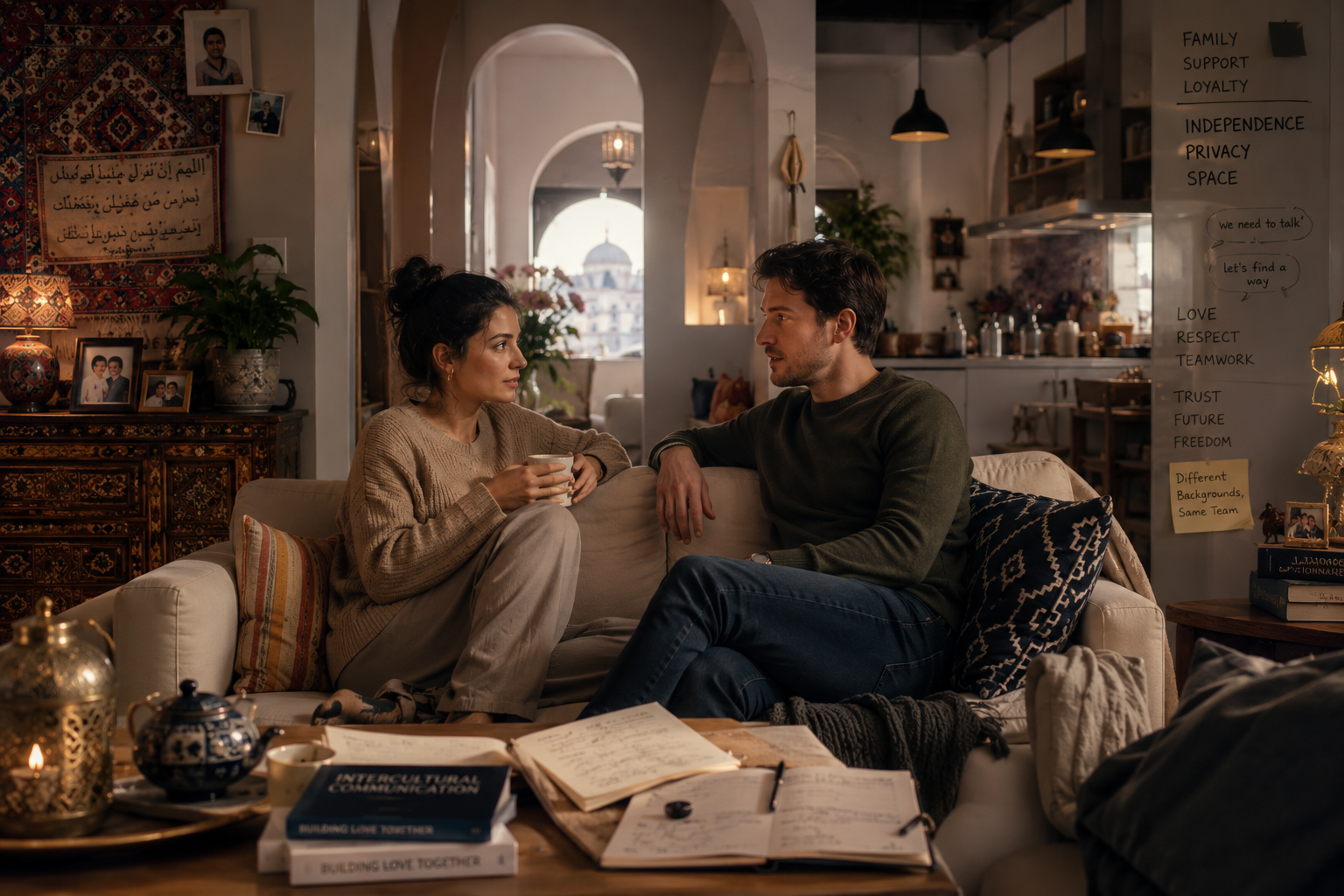
Relocation adds pressures most therapy models were not built for. One partner adapts faster. One sacrificed a career. Money becomes lopsided, sometimes creating dependence nobody planned. Add language differences, family expectations from two directions, and differing beliefs about marriage and gender roles, and ordinary conflict gains a second layer.
Homesickness, loneliness, relocation stress, and the recurring question of whether to stay or go home all land inside the relationship. So does cross-border living. A therapist who understands this context will not misread a cultural difference as a character flaw, the mistake that makes couples give up on therapy.
That said, culture explains some conflict, not all of it. Sometimes two people simply have a problem. The deeper version is in how relocation changes expat couples.
Sometimes the couple is not only negotiating a disagreement. They are negotiating two cultures, two families, and two different versions of what a relationship should be.
When Couples Therapy May Not Be Appropriate
Standard joint couples therapy is not appropriate when one partner is not safe. That includes active domestic violence, coercive control, fear of retaliation, serious intimidation, or any situation where someone cannot speak honestly without consequences afterwards. Being candid in the room is precisely what makes it dangerous.
It may also need to wait where there is immediate danger or an untreated acute crisis requiring individual or emergency care first. In those situations, safety planning, individual support, specialist domestic-abuse services, or emergency help are the right starting point, not joint sessions.
None of this means ordinary conflict is abuse. Most couples arguing badly are not in danger. But the distinction matters enough to state plainly.
How to Prepare for Couples Therapy
Preparation mostly means arriving with a shared question rather than a prosecution file. A little thought beforehand makes early sessions far more useful, because the first appointment is short and the pattern you need to describe took years to build.
- Agree on what you want help with, even loosely
- Write down the repeating pattern, not last week's argument
- Choose a therapist you can both speak honestly with
- Expect discomfort without treating it as failure
- Never use therapy as a threat
- Be willing to examine your own contribution
- Protect privacy and time for sessions
- Decide how you will practise changes between appointments
When to Consider Couples Therapy
You do not need a crisis to qualify. Many couples come because something is drifting and would rather address it early, which is also when therapy works best. Preventive work before marriage, a relocation, or a new baby is a legitimate reason to go.
Worth considering when you notice recurring unresolved conflict, emotional distance, damaged trust, intimacy difficulties, parenting or money disagreements, strain from relocation or career change, communication turning defensive or contemptuous, or uncertainty about staying together.
Repeating the same argument, feeling disconnected, or struggling with the pressure of life abroad? Expathy connects expat couples with licensed psychologists who understand international relationships and can support partners online. Explore couples therapy.
Frequently Asked Questions
Does couples therapy actually work?
For many couples, yes. A 2022 meta-analysis in Couple and Family Psychology: Research and Practice found roughly 70 percent of couples were symptom free after Emotionally Focused Therapy across 20 studies. Outcomes depend on both partners participating, therapist fit, honesty, and how early help is sought.
Is couples therapy worth it?
It is usually worth it when both partners care and neither can break the pattern alone. It is less likely to help when one partner has already decided to leave, or when someone cannot speak safely. Weigh the cost against what the pattern already costs you.
How long does couples therapy take?
There is no fixed number of sessions. Focused issues may resolve in a handful of appointments, while long-standing patterns or betrayal generally take longer. Weekly sessions are common initially, reducing as progress builds. Be sceptical of anyone guaranteeing a timeline.
Will a couples therapist take sides?
A good therapist does not act as a judge or award points. But neutrality does not mean treating everything as equivalent. A skilled therapist holds both partners fairly while still naming manipulation, betrayal, intimidation, or contempt directly when it appears.
Can couples therapy help after infidelity?
Yes, and it is among the most common reasons couples seek help. Work usually involves understanding what happened, managing the immediate distress, rebuilding trust gradually, and deciding honestly whether to continue. Recovery is possible but rarely fast, and it requires full transparency.
Can one partner attend couples therapy alone?
Often yes. Individual work focused on relationship patterns can help you understand your own contribution and clarify what you want. It cannot replace joint work, but one person changing their part of a loop frequently shifts the whole loop.
What if my partner refuses couples therapy?
Refusal is common and often about fear of blame rather than lack of care. Explain what you want help with rather than what they should fix, offer a single trial session, and let them help choose the therapist. Individual therapy remains useful otherwise.
Is online couples therapy effective?
Research suggests it is comparable to in-person work for many couples. A 2022 randomized controlled trial in Frontiers in Psychology found no significant difference in relationship satisfaction, mental health, or therapeutic alliance between videoconference and face-to-face delivery. Reliable privacy still matters.
What is the difference between couples therapy and marriage counselling?
In practice, very little. Marriage counselling usually refers to work with married partners, while couples therapy and couples counselling cover any committed relationship regardless of marital status. Training and therapist skill matter far more than the label used.
When is couples therapy not appropriate?
Joint therapy is not appropriate where there is active domestic violence, coercive control, fear of retaliation, or any situation in which one partner cannot speak honestly without repercussions. Immediate danger or an acute untreated crisis needs individual, specialist, or emergency support first.
Need support? We're here.
Book a free 15-min consultation with our expat-specialized therapists.